
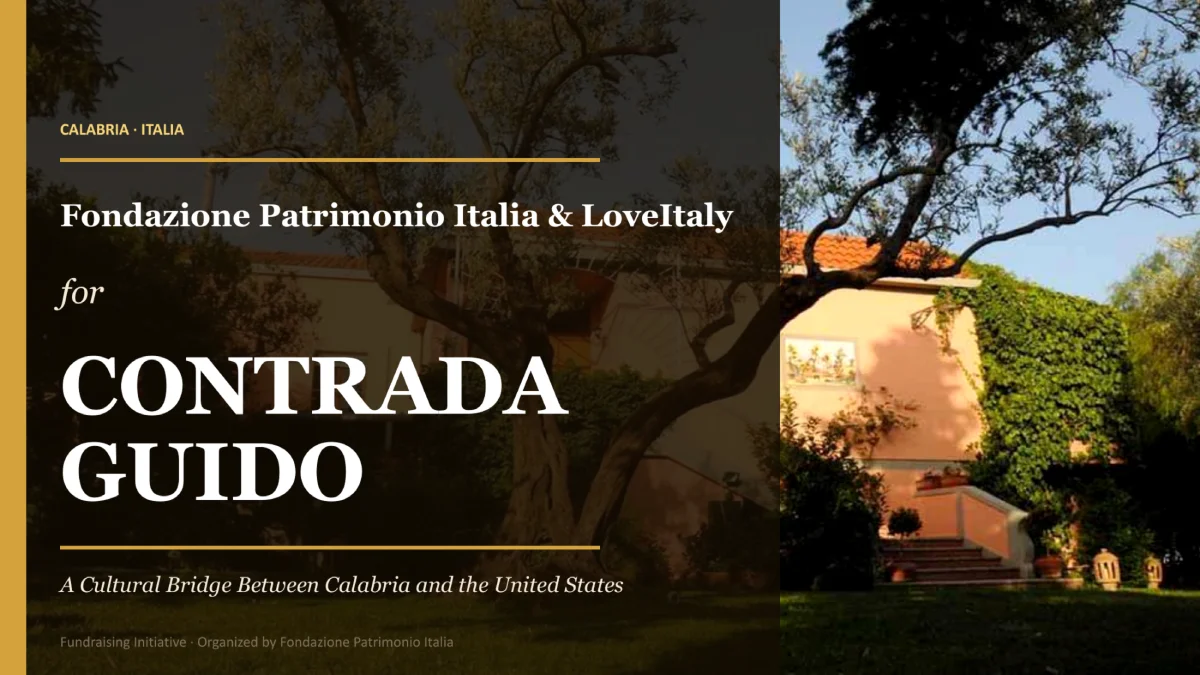
Contrada Guido – A Cultural Bridge Between Calabria and the United States
The Contrada Guido project, promoted by Fondazione Patrimonio Italia in collaboration with LoveItaly, is an international patronage initiative aimed at enhancing an important historical and cultural heritage located on the Ionian coast of Calabria. The goal is to transform a historic residence into a cultural and artistic hub connecting Italy and the United States, particularly strengthening the bond with the Italian-American community.
As highlighted in the executive summary (p. 2), the initiative aims to restore and revitalize Contrada Guido, converting it into a space where historical heritage, contemporary art, and transatlantic dialogue coexist. The project is based on an international fundraising model: donations are channeled through a US 501(c)(3) nonprofit organization, making them tax-deductible in the United States and encouraging the participation of American investors and benefactors.
From a historical perspective (p. 3), Contrada Guido is a place of great significance: active since the 18th century as a rural center on the Ionian coast, it has been an agricultural and social hub for centuries. The property has passed through prominent local families, including the Talaricos and the Mottolas of Amato, and over the years has hosted prominent institutional, religious, and artistic figures, consolidating a tradition of cultural openness.
The operational core of the project (p. 4) is structured around several concrete interventions. These include the restoration of the Church of the Madonna del Rosario and a rare 19th-century fresco, the conversion of agricultural structures into artist studios and workspaces, and the creation of an open-air contemporary art park. Also central to the project is the residency program for American artists, which aims to host young talents in the spaces of Contrada Guido, fostering creative exchange between Italy and the United States.
The Fondazione Patrimonio Italia (p. 5), the project’s promoter, is already active in cultural promotion through initiatives such as the Talent Prize and the Art Symposium, events involving emerging artists and leading institutions. This ecosystem provides the project with a solid foundation in terms of expertise, visibility, and organizational capacity.
Another strategic element is represented by the media partners (p. 6), including Inside Art and Associated Media, who ensure international coverage and strong visibility for donors and the project’s activities, helping to build a global narrative of the initiative.
The expected cultural impact (p. 7) is broad and multifaceted: from the preservation of historical heritage to the promotion of cultural diplomacy between Italy and the United States, from support for emerging artists to the promotion of tourism in Calabria. Particularly relevant is the theme of reconnecting Italian Americans with their roots, through a direct and participatory experience.
The economic participation model (p. 8) provides for different levels of donation, each with increasing benefits in terms of access, visibility, and involvement. As highlighted in the following pages (pp. 9-10), the project offers concrete benefits to donors, including tax deductions in the United States, access to the Schengen Area, and, for higher-level donors, the possibility of accessing tools such as the Italian Investor Visa and favorable tax regimes.
Finally, as emphasized in the concluding section (pp. 11-12), Contrada Guido presents itself as a true intersection of culture, investment, and identity. It is not just a restoration project, but a strategic project that combines heritage, cultural innovation, and international relations, offering participants the opportunity to actively contribute to the preservation and promotion of Italian culture from a global perspective.